
How Often Should AC Filters Be Replaced in Belton, Texas Homes?

The number on the filter box is not the right answer for most Belton homes. Most packaging lists a 60- to 90-day replacement window, but those guidelines assume average use in an average climate. Central Texas is neither of those things.
Our air conditioning maintenance team gets this question a lot from homeowners who've been following the package directions faithfully and wondering why their system has been struggling anyway. The short version: you need to change your filter more often than the box says, and in some households, a bit more often than that.
The AC runs more hours per year here than the filter guidelines assume. And Central Texas air carries more particulate than most. Both of those things push a filter past its useful life faster than generic guidance accounts for.
Getting this wrong has real consequences for how the system performs, which is exactly why working with a trusted local HVAC service provider in Belton, TX, makes a difference. They know what your home is actually up against.
Why Texas Changes the Filter Replacement Timeline
In much of the country, a home's central AC runs actively for three or four months out of the year. In Belton, you're looking at six or more months of consistent operation, with July and August pushing many systems into near-constant run cycles during peak heat.
That's roughly double the annual hours of air movement compared to a northern climate, which means double the particulate captured in the same time frame. Bell County also brings its own air quality burden. The following contribute heavily to filter load:
- Cedar and mountain cedar season
- Ragweed through the warmer months
- Grass pollen
- Agricultural dust from surrounding land
- Construction dust for homeowners near active development in the Killeen and Temple areas
The filter captures what the air carries. Central Texas air tends to carry a lot, and the filter reflects that quickly.
The Replacement Schedule That Works for Most Belton Homes
For a standard 1-inch pleated filter in a home without pets and without significant air quality concerns, plan on 30 to 45 days during the cooling season. Not 60. Not 90. The 30-to-45-day window keeps airflow where it needs to be and prevents the gradual restriction that causes the system to strain.
Staying on top of filter changes is one of the simplest forms of AC maintenance a homeowner can do, yet our indoor air quality services team often gets called in after months of running a clogged filter have contributed to buildup problems deeper in the system, all of which a timely filter swap would have prevented.
Homes with one or more pets should shorten that to 20 to 30 days. Pet dander accumulates quickly enough that a household with two shedding dogs can hit borderline restriction in under three weeks during peak AC season.
If anyone in the home has allergies or asthma, lean toward the shorter end regardless of the pet situation. Cleaner filtration matters more in these households, and the filter is the first line of defense against what circulates through the system every time the air handler kicks on.
What Shortens the Window Even Further
A few situations push the schedule tighter than 30 days. Living near active construction is one of the most significant. Drywall dust, concrete particulate, and disturbed soil travel on the air, and homes downwind of an active development can load a filter in two weeks.
Homes on unpaved roads, or with older ductwork that isn't properly sealed at its joints, face a similar problem. Duct gaps pull in attic and wall dust that bypasses the return register and reaches the filter before it's filtered through the living space.
High-occupancy households simply move more air and introduce more particles per day. Kids tracking in from outside, frequent guests, and multiple occupants all contribute to this increase. Each of these raises the daily particulate load.
If the ductwork itself has years of buildup, the filter catches more per cycle than it would in a clean system. A professional duct cleaning can reset that baseline so filters last their intended window rather than loading up in half the time.
What Happens When the Filter Sits Too Long
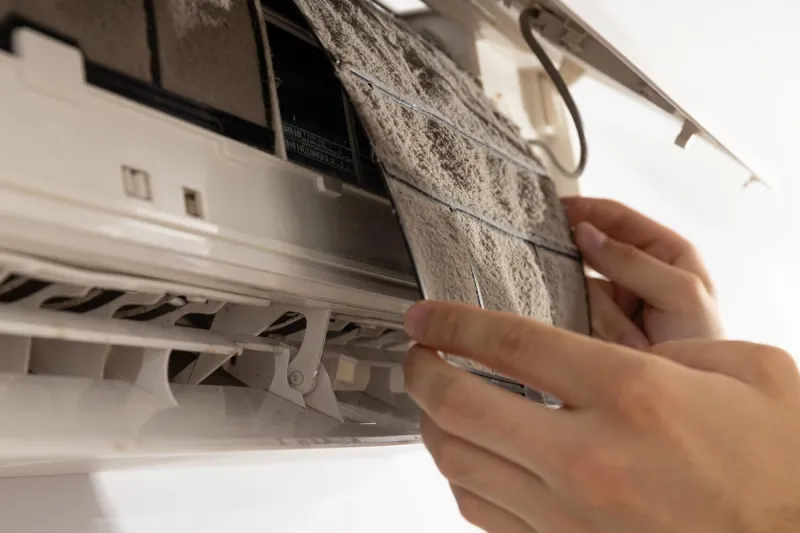
A clogged filter doesn't fail slowly and gracefully. The blower motor is built to pull air through at a specific rate, and when the filter gets loaded up, that rate drops. The blower strains. Electricity draw goes up, motor wear accelerates, and neither of those things shows up right away. They show up on your bill. And then, eventually, in a service call.
If the restriction gets bad enough, the evaporator coil starts running too cold. It needs continuous airflow across its surface just to stay above freezing. Without that, ice forms. A frozen coil can't absorb heat from the air at all, so the system just keeps running, you know, doing nothing useful.
That scenario in August almost always turns into an emergency call. Compressor damage is possible when it goes on long enough, and that repair costs far more than a season's worth of filters combined. It's kind of a brutal trade-off for something so easy to prevent.
That's exactly why choosing the best AC repair company matters before things get to that point. A good team will catch airflow issues early, check the coil, and flag filter problems before they turn into something a lot more expensive.
MERV Ratings and What They Mean for Your Schedule
MERV stands for Minimum Efficiency Reporting Value. It measures how fine the filter's filtration is, with higher numbers capturing smaller particles.
- MERV 1 to 4 (Basic fiberglass; protects equipment only): Change monthly or more often.
- MERV 8 to 11 (Standard pleated; balances filtration and airflow): Change every 30 to 45 days in Central Texas.
- MERV 13 and above (Captures very fine particles; restricts airflow more noticeably): Window can be similar to or shorter than standard pleated under heavy particulate conditions.
Important note on high-MERV filters: Not every residential system was designed to handle the additional restriction of a MERV 13+ filter without efficiency losses or shortened component life. Before upgrading, it's worth confirming your unit can handle it.
Our team covers this during Comfort Care maintenance visits, a simple compatibility check that prevents the unintended consequence of buying a better filter that ends up working against the system it was meant to protect.
Frequently Asked Questions
How often should I change my AC filter in Belton, Texas? For most Belton-area homes using a standard 1-inch pleated filter, 30 to 45 days during the active cooling season is the right target. Homes with pets or allergy concerns should aim for every 20 to 30 days. The 90-day guideline on most packaging does not reflect Central Texas conditions.
Does my filter type change how often I need to replace it? Yes, it does. Fiberglass filters in the low MERV range need changing monthly or more often. Thicker 4- to 5-inch media filters have more surface area and can last several months, but still need regular checks during peak season. Higher MERV filters load up faster under heavy particulate conditions, so the window can be similar to or shorter than a standard pleated filter.
What happens if I don't change my AC filter on time? Restricted airflow puts the blower motor under extra strain and, if severe, causes the evaporator coil to ice over. A frozen coil produces no cooling regardless of how long the system runs. This commonly leads to an emergency repair call during the hottest days of summer. Sustained airflow restriction over time also shortens the working life of the blower motor and compressor.
Can a dirty filter actually damage the AC system? Yes, over time it can. The blower motor and the compressor handle the mechanical consequences of restricted airflow, and both are expensive to repair or replace. A filter changed on schedule costs a fraction of what either repair runs. It's one of the most straightforward preventive habits a homeowner can build.
How do I know which MERV rating is right for my system? Your unit's documentation will list a recommended filter type, sometimes including a maximum rated MERV. If you don't have that documentation, our team can confirm the right choice during a maintenance appointment. Some systems handle high-MERV filters without issue; others see efficiency and comfort problems when the restriction increases past what they were designed for.
Contact Us
Have questions or need support? We’re here to help! You can reach the team at Alltek Services by phone at (254) 721-7049 Ext. 2 or by email at info@AlltekServices.com for quick answers and assistance.
Stop by our office at 1181 Farm-To-Market Rd 2271, Belton, TX 76513, or fill out the contact form on our site with your message, and we’ll get back to you as soon as we can.