Static Pressure Testing for AC Systems in Belton, Texas Homes

Most homeowners only think about their AC system when something obvious breaks. The compressor stops, the system won't turn on, or the house gets hot enough that the problem is undeniable.
Less attention goes to the patterns that build gradually: rising energy bills, rooms that never get quite as cool as they should, and a system that runs harder than it used to without any clear explanation.
Static pressure testing is one of the diagnostic tools our air conditioning team uses to find those quieter problems. It measures what's happening inside the duct system. It often explains comfort and efficiency issues that a standard service visit won't surface on its own.
If you've been chasing the same issues season after season, this is maybe the test you've been missing. A reliable HVAC services provider runs this kind of check not as an afterthought but as part of actually understanding your system.
What Static Pressure Actually Measures
Every duct system has resistance. Air moving through duct runs, around bends, and through register grilles encounters resistance at every point. Some resistance is unavoidable and was accounted for in the system's original design. The problem starts when total resistance exceeds what the system was rated to handle.
Manufacturers set a maximum total external static pressure for every air handler they produce. That number is the ceiling, the maximum resistance the blower can push against while still moving the volume of air the system needs to condition the space properly. Running consistently over that ceiling causes:
- Increased energy use
- Accelerated motor wear
- Unexpected AC repair calls that trace back to this exact issue
Knowing the warning signs of an AC compressor failure matters here too. Chronic high static pressure puts sustained stress on the compressor, and a blower working against excessive resistance long enough will eventually show it through hard starts, unusual noises, or a system that trips the breaker repeatedly before any other obvious cause is found.
How the Test Gets Done
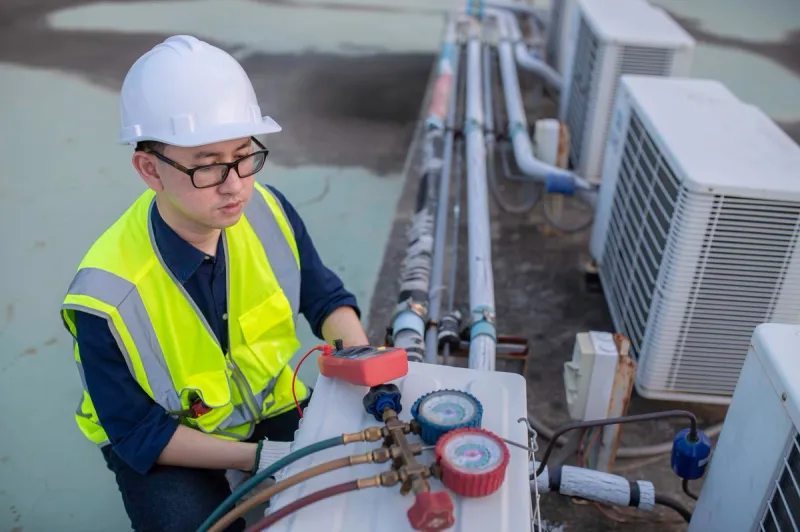
The test requires two measurement points: the supply and return plenums. The supply plenum is the chamber just after the air handler where conditioned air enters the ductwork heading toward the registers.
The return plenum is just before the air handler, where air from the house enters to be reconditioned. A technician places measurement ports at each location and uses a digital manometer to read the pressure at both points.
The technician adds the two readings to get the total external static pressure. The technician then compares that number to the air handler manufacturer's specification. The whole process takes about 10 to 15 minutes. The technician plugs the test ports when done, leaving no lasting mark on the equipment.
The result is useful because it's an objective number rather than a subjective observation. A reading either exceeds the rated maximum, or it doesn't, and that clarity narrows down where to look next. It pairs well with a full AC maintenance appointment, where other system checks happen in the same visit.
What High Static Pressure Points To
High static pressure is the more common finding, and it tells a consistent story: the blower is working harder than it should to move air through the system. The causes range from simple to structural.
On the simpler end, a loaded air filter or a dirty evaporator coil creates localized restriction that inflates the pressure reading. Cleaning the filter or the coil brings the number back down.
Structural causes require more investigation. Ductwork that's undersized for the system's airflow requirements creates permanently elevated pressure, no matter how clean the filter is.
Flex duct that has been kinked, compressed, or shifted since installation does the same thing. Too many closed supply registers force the system's full airflow through fewer outlets, raising pressure throughout the system and starving rooms at the far ends of long duct runs.
Energy bills climb, blower motor lifespan shortens, and comfort suffers in a way that can be hard to trace without measuring. Our duct cleaning service addresses the buildup-related causes directly; ductwork modification or replacement handles the structural ones.
What Low Static Pressure Indicates
Low static pressure doesn't mean everything is running smoothly. It usually means air is escaping the duct system before it reaches the registers.
Common causes of low static pressure:
- Separated joints in the ductwork
- Holes in the flex duct wrap
- Sections that have disconnected from their connections in the attic
These allow conditioned air to dump into unconditioned spaces. The blower doesn't encounter expected resistance because part of what it moves never makes it into the living space.
Oversized equipment presents differently. A unit too large for the space satisfies the thermostat before fully removing moisture from the air. The result is a house that reads the right temperature but feels humid and uncomfortable.
How each issue is addressed:
- Ductwork leakage: repaired and sealed directly
- Oversizing: prevented through a proper load calculation before any new HVAC installation
Why Bell County Homes Are More Susceptible to These Problems
Ductwork running through Central Texas attics faces conditions that ductwork in milder climates doesn't encounter. Summer attic temperatures in Belton regularly reach 130 to 150 degrees Fahrenheit. That heat causes the flex duct to expand and contract every day of the cooling season.
Over time, connectors loosen, joints separate, and the insulation wrapping the duct's exterior degrades. What was a tight, properly connected system at installation gradually develops leaks and pressure changes, often without any single visible event causing it.
Many homes in Bell County also have duct systems that were modified after original construction. Room additions, garage conversions, and home expansions often extend the existing ductwork without recalculating whether the trunk lines can support the additional load. The system may have performed well when the house was smaller.
Now the ductwork is undersized for its current job, which shows up as elevated static pressure throughout the supply side. Static pressure testing confirms the issue quickly, and from there, targeted duct corrections often extend the equipment's useful life without requiring a full HVAC system replacement.
When to Request Static Pressure Testing
The most direct signal is uneven comfort. Some rooms cool well; others consistently run warm, no matter how long the system runs. If a standard service visit has confirmed the equipment is functioning properly and the problem persists, the duct system is the next logical area to examine.
Other situations that warrant the test include before and after any ductwork modification or extension; when a new system is being installed, to confirm the existing ductwork can support the new equipment; and when energy bills keep climbing without a clear mechanical cause.
A system that recently had new equipment installed also deserves a pressure check. Installation doesn't always include verifying that the existing duct system matches the new unit's airflow requirements, and a high-performing unit can still underdeliver in ductwork that throttles its output.
Our Comfort Care maintenance program includes thorough system assessments that go beyond filters and coils. Comfort problems often have more than one contributing factor, and finding airflow issues before they damage equipment or drive up utility costs is exactly what preventive maintenance is built around.